
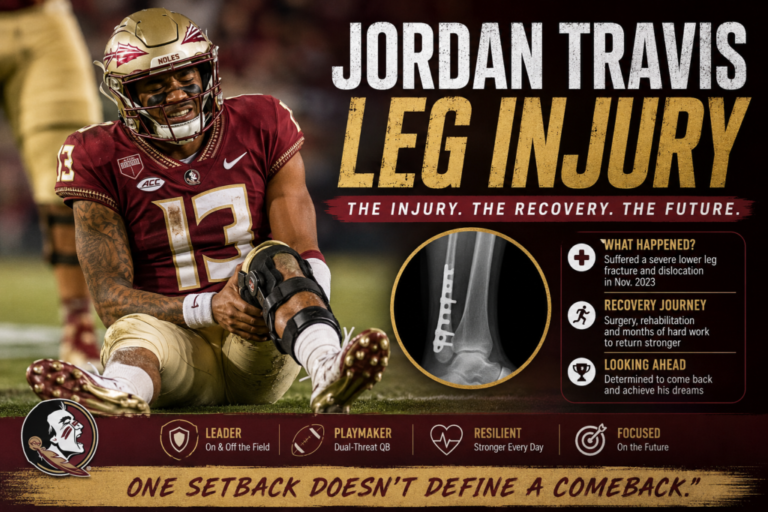
Few moments in college football have been as heartbreaking in recent years as the injury that abruptly ended one of the sport’s most inspiring seasons. The jordan travis leg injury not only changed the trajectory of Florida State’s championship aspirations but also sparked widespread conversations about athlete safety, recovery science, and the resilience required to return from a devastating setback.
Jordan Travis had become the face of Florida State football. His leadership, athleticism, and ability to perform in high-pressure situations transformed the Seminoles into one of the nation’s elite programs. When the injury occurred late in the 2023 season, fans, teammates, coaches, and NFL scouts immediately recognized its significance.
This comprehensive guide explores every aspect of the injury—from what happened on the field and the medical diagnosis to the recovery process, NFL implications, and long-term outlook. Whether you’re a football enthusiast, sports analyst, or someone interested in sports medicine, this article provides an in-depth examination of one of college football’s most discussed injuries.
Understanding the Jordan Travis Leg Injury
The jordan travis leg incident occurred during Florida State’s matchup against North Alabama in November 2023. What initially appeared to be a routine play quickly transformed into a shocking moment that silenced the stadium.
As Travis scrambled with the football, he became entangled in a tackle that resulted in a severe lower-leg injury. Television broadcasts immediately shifted away from replay angles due to the graphic nature of the incident. Players from both teams appeared visibly shaken, highlighting the seriousness of the situation.
The injury drew national attention because of several factors:
- Florida State was competing for a College Football Playoff berth.
- Travis was enjoying a career-defining season.
- NFL scouts were actively evaluating his professional potential.
- The injury occurred at a critical point in the season.
The emotional response from teammates and coaches reflected the impact Travis had on the program. Beyond statistics and wins, he had become a respected leader whose presence helped reshape Florida State football.
Jordan Travis Before the Injury: A Rising Star
To understand the significance of the setback, it’s important to appreciate the level at which Travis was performing before the injury.
Over several seasons, he evolved from a talented dual-threat quarterback into one of the most effective players in college football. His ability to extend plays, create opportunities with his legs, and deliver accurate passes made him a difficult challenge for opposing defenses.
Key strengths that defined his game included:
- Elite mobility and escapability
- Strong decision-making under pressure
- Leadership qualities
- Improved passing efficiency
- High football intelligence
NFL evaluators increasingly viewed him as a developmental quarterback with intriguing upside. While questions existed regarding size and traditional pocket-passing traits, his athletic profile and competitive toughness consistently impressed scouts.
The jordan travis leg injury suddenly forced evaluators to reassess projections that had been steadily rising throughout the season.
Medical Breakdown: What Happened to the Leg?
Sports injuries often appear straightforward to casual viewers, but severe lower-extremity trauma can involve multiple structures.
The jordan travis leg injury was widely reported as a significant lower-leg fracture and dislocation. Such injuries typically involve damage to bones, ligaments, surrounding soft tissue, and joint stability mechanisms.
Medical professionals generally evaluate these injuries according to several criteria:
| Evaluation Area | Importance |
|---|---|
| Bone Damage | Determines healing timeline |
| Joint Stability | Impacts future mobility |
| Ligament Integrity | Affects long-term performance |
| Soft Tissue Condition | Influences rehabilitation |
| Nerve Function | Critical for athletic recovery |
When a fracture is accompanied by dislocation, treatment complexity often increases significantly. Surgeons must not only repair damaged bone structures but also restore proper alignment and joint mechanics.
Modern orthopedic techniques have dramatically improved outcomes compared with previous decades. Athletes who once faced career-ending prognoses now regularly return to elite competition through advanced surgical intervention and rehabilitation.
The Immediate Response and Emergency Treatment
The moments following the injury demonstrated the professionalism and preparedness of medical personnel.
Athletic trainers and physicians quickly entered the field and stabilized Travis. Their primary objective was preventing additional damage while safely transporting him for further evaluation.
Emergency response protocols in major college football programs typically include:
- Immediate injury assessment
- Limb stabilization
- Pain management
- Neurovascular evaluation
- Transportation planning
These procedures may seem routine, but they play a critical role in determining long-term outcomes. Prompt treatment reduces the likelihood of complications and creates a foundation for successful recovery.
For athletes, the psychological impact begins almost immediately. The realization that a season—and potentially a career path—has changed can be emotionally overwhelming. This mental challenge often becomes just as important as physical healing.
How the Injury Affected Florida State’s Season
The jordan travis leg injury extended far beyond one player’s health.
Florida State had built much of its offensive identity around Travis’s unique skill set. His mobility created opportunities that few quarterbacks could replicate, forcing defenses to account for him on every snap.
Following the injury, the Seminoles faced several challenges:
- Adjusting offensive strategy
- Replacing veteran leadership
- Maintaining team confidence
- Managing national expectations
- Competing for playoff consideration
Many analysts argued that the injury significantly influenced perceptions of Florida State’s playoff viability. Even though the team continued winning games, discussions increasingly focused on whether the roster remained the same without its star quarterback.
The situation reignited debates about how injuries should influence championship selection processes and team evaluations.
Rehabilitation Process: The Long Road Back
Recovering from a major lower-leg injury is rarely a straightforward process.
The rehabilitation journey associated with the jordan travis leg recovery likely involved multiple stages designed to progressively restore function and athletic performance.
Typical rehabilitation phases include:
Phase 1: Protection and Healing
During this stage, the primary goals include:
- Protecting surgical repairs
- Reducing inflammation
- Managing pain
- Preserving overall health
Athletes often experience the greatest frustration during this phase because activity limitations are extensive.
Phase 2: Mobility Restoration
Once healing progresses, therapists focus on:
- Range-of-motion exercises
- Joint flexibility
- Basic weight-bearing activities
- Controlled movement patterns
This stage lays the groundwork for future athletic performance.
Phase 3: Strength Development
Strength rebuilding commonly targets:
- Calf muscles
- Quadriceps
- Hamstrings
- Hip stabilizers
- Core musculature
The objective is restoring symmetry and functional power.
Phase 4: Sport-Specific Training
Athletes gradually reintroduce:
- Sprinting
- Cutting movements
- Directional changes
- Throwing mechanics
- Competitive drills
This stage often determines readiness for return to competition.
Psychological Challenges During Recovery
One frequently overlooked aspect of major sports injuries is the mental recovery process.
Athletes often describe rehabilitation as emotionally demanding because progress rarely follows a perfectly linear path. There are setbacks, plateaus, and moments of uncertainty.
“A truly great piece of content doesn’t just satisfy search engine algorithms; it builds genuine trust with real readers.”
That same principle applies to rehabilitation. Successful recovery isn’t solely about physical milestones; it’s about rebuilding confidence and trust in the body.
The jordan travis leg recovery required navigating concerns such as:
- Fear of reinjury
- Performance anxiety
- Career uncertainty
- Isolation from teammates
- Public expectations
Sports psychologists increasingly play a central role in helping athletes address these challenges. Mental resilience can significantly influence rehabilitation outcomes.
For quarterbacks in particular, confidence is essential. Mobility, pocket movement, and decision-making often depend on trusting one’s physical capabilities.
NFL Draft Implications and Professional Outlook
Before the injury, Travis had generated increasing interest among NFL organizations.
The jordan travis leg setback introduced additional variables into the scouting process. Teams needed to evaluate not only his previous performance but also his future health outlook.
NFL decision-makers typically assess injured prospects according to:
- Medical reports
- Surgical outcomes
- Recovery progression
- Athletic testing
- Long-term durability projections
Despite the injury, many evaluators remained optimistic due to advances in sports medicine. Teams increasingly recognize that modern rehabilitation can restore athletes to remarkably high levels of performance.
Factors working in Travis’s favor included:
- Strong collegiate production
- Proven leadership
- Competitive toughness
- Positive reputation
- Demonstrated work ethic
Organizations often value resilience as much as physical talent. Successfully navigating a significant injury can reveal character traits that translate well to professional football.
Comparing Similar Quarterback Injuries
History provides valuable context when evaluating major football injuries.
Several notable quarterbacks have overcome severe lower-body injuries and returned to productive careers.
| Player | Injury Type | Return Outcome |
|---|---|---|
| Alex Smith | Complex leg fracture | Returned to NFL competition |
| Joe Burrow | Knee injury | Returned to elite performance |
| Teddy Bridgewater | Severe knee trauma | Continued NFL career |
| Carson Palmer | Major knee injury | Successful return |
| Deshaun Watson | ACL injury | Returned to starting role |
While every injury differs, these examples illustrate how modern medicine and rehabilitation have transformed expectations.
The jordan travis leg situation inevitably invited comparisons to these recovery stories. Each athlete faced unique circumstances, but their experiences demonstrated that severe injuries do not automatically end promising careers.
What Recovery Success Looks Like
Recovery should not be measured solely by returning to the field.
For quarterbacks, successful rehabilitation often involves multiple benchmarks:
- Walking without limitations
- Regaining full range of motion
- Restoring strength symmetry
- Recovering athletic explosiveness
- Returning to competitive football
The jordan travis leg rehabilitation process likely focused heavily on restoring functional movement rather than merely achieving medical clearance.
Performance metrics often include:
- Sprint speed
- Agility testing
- Balance assessments
- Throwing mechanics
- Endurance levels
These indicators help medical teams determine whether an athlete is prepared for the demands of elite competition.
Lessons for Athletes and Sports Programs
Major injuries often create learning opportunities for athletes, coaches, and organizations.
The circumstances surrounding the jordan travis leg injury highlight several important lessons:
Importance of Medical Resources
Elite rehabilitation requires access to:
- Orthopedic specialists
- Physical therapists
- Athletic trainers
- Sports psychologists
- Strength coaches
Long-Term Development
Athletes benefit from:
- Proper conditioning
- Movement training
- Recovery strategies
- Injury prevention programs
Mental Resilience
Perhaps the most valuable lesson is that adversity can reveal extraordinary resilience.
Many athletes emerge from rehabilitation with a deeper appreciation for their sport and a stronger understanding of personal perseverance.
The Future of Jordan Travis
Projecting future performance after a serious injury always involves uncertainty.
However, several factors support optimism regarding Travis’s long-term outlook:
- Young age
- Access to elite medical care
- Strong work ethic
- Proven competitiveness
- Continued advancements in rehabilitation science
The jordan travis leg injury will always remain part of his story, but it does not have to define his future.
Many athletes discover that overcoming adversity becomes a source of strength. The discipline, patience, and determination required during rehabilitation often translate into personal and professional growth.
As football continues evolving, organizations increasingly evaluate prospects through a holistic lens that includes character, leadership, and resilience. Travis has demonstrated those qualities throughout his career.
FAQ
What was the jordan travis leg injury?
The jordan travis leg injury was a severe lower-leg fracture and dislocation suffered during Florida State’s game against North Alabama in November 2023. The injury required immediate medical attention and ended his collegiate season.
How serious was Jordan Travis’s injury?
The injury was considered highly serious due to the combination of fracture and dislocation. Such injuries often require surgery, extensive rehabilitation, and months of recovery before athletes can return to competitive sports.
Did the injury affect Jordan Travis’s NFL prospects?
Yes. The injury introduced additional uncertainty into the evaluation process. NFL teams needed to assess recovery progress and long-term durability alongside his football skills and collegiate performance.
How long does recovery from a major leg injury typically take?
Recovery timelines vary significantly based on injury severity and individual healing rates. Athletes may spend many months progressing through surgical recovery, physical therapy, strength rebuilding, and sport-specific training before returning to competition.
Can quarterbacks return to their previous level after severe leg injuries?
Many quarterbacks have successfully returned from significant lower-body injuries. Advances in orthopedic surgery, rehabilitation techniques, and sports medicine have improved outcomes considerably over the past two decades.
What made Jordan Travis important to Florida State?
Jordan Travis served as the team’s leader and offensive catalyst. His dual-threat abilities, experience, and leadership played a major role in Florida State’s resurgence as a national contender.
What lessons can athletes learn from the jordan travis leg recovery journey?
Athletes can learn the value of perseverance, patience, mental resilience, and commitment to rehabilitation. Recovery from major injuries often requires as much psychological strength as physical effort.
Conclusion
The story of the jordan travis leg injury is ultimately about more than a medical diagnosis. It represents a defining moment in the career of a talented quarterback whose leadership helped elevate an entire football program. While the injury abruptly halted a remarkable season, it also showcased the resilience, determination, and support systems that characterize elite athletics.
From the immediate medical response and surgical treatment to the demanding rehabilitation process and NFL evaluation challenges, every stage of the journey highlights the complexity of modern sports recovery. The injury undeniably altered the trajectory of one season, but it also revealed the qualities that often define long-term success: perseverance, adaptability, and unwavering commitment.

0 Comments