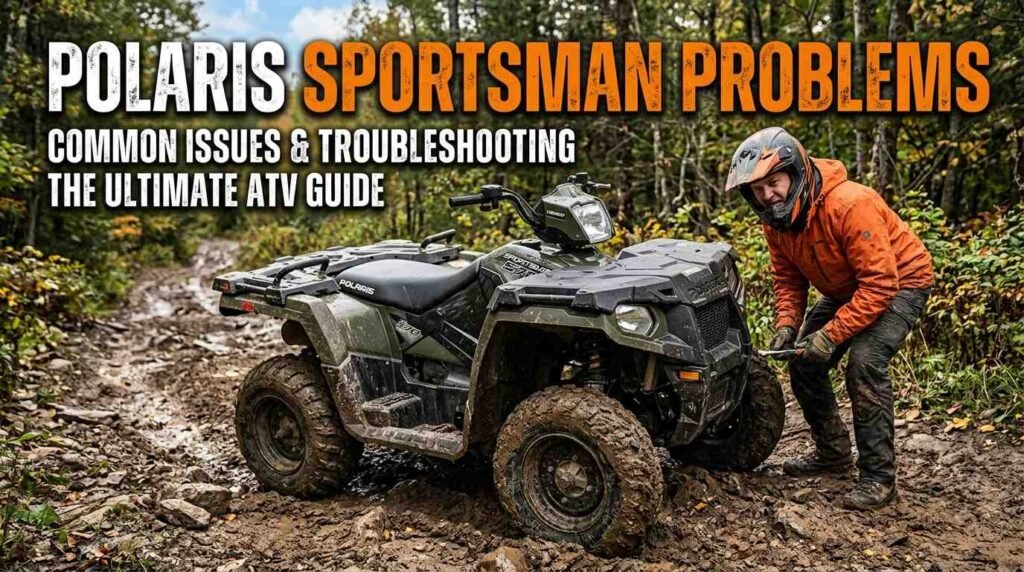
The Polaris Sportsman is a popular utility ATV for trail riding, hunting, farm work, and hauling equipment. But like any machine, it can develop problems with starting, electrical systems, engine performance, shifting, or four-wheel drive.
If your Sportsman suddenly refuses to start, loses power halfway through a ride, or develops a burning smell near the drive belt, you need more than a list of possible defects. You need to understand what might be causing the problem, which checks you can perform yourself, and when it makes sense to call a mechanic.
This guide covers common Polaris Sportsman problems, practical troubleshooting steps, maintenance tips, and advice for anyone considering a used model. Keep in mind that the exact causes and repair procedures depend on your ATV’s model, year, and configuration.
What Are the Most Common Polaris Sportsman Problems?
Polaris Sportsman ATVs come in several engine sizes and configurations, so their problems can vary. Some symptoms point toward routine maintenance issues, while others may indicate a more serious mechanical or electrical fault.
Here are the main problem areas worth checking when your ATV isn’t performing as expected.
| Common symptom | Possible causes to investigate |
|---|---|
| ATV won’t start | Weak battery, fuel delivery issue, ignition fault, or electrical connection |
| Engine cranks but won’t fire | Fuel, spark, compression, or sensor-related problem |
| Battery keeps dying | Weak battery, charging-system fault, or electrical drain |
| Engine stalls or loses power | Fuel restriction, ignition issue, airflow problem, or overheating |
| Hard shifting | Shift mechanism, drivetrain alignment, or transmission-related fault |
| Burning smell near the belt | CVT belt slipping, overheating, or clutch-related issue |
| AWD won’t engage | Electrical, control, sensor, or drivetrain problem |
| Engine overheats | Blocked cooling airflow, low coolant on liquid-cooled models, or cooling-system fault |
These are starting points, not confirmed diagnoses. Two ATVs can show the same symptom for completely different reasons.
For example, a Sportsman that clicks when you press the starter may have a weak battery or poor electrical connection. If the engine cranks normally but never starts, the battery may be fine, and the problem could involve fuel delivery or ignition.
1. Polaris Sportsman Won’t Start
A Polaris Sportsman that won’t start can turn a planned hunting trip or weekend ride into a frustrating afternoon. Before replacing expensive components, determine exactly what happens when you press the starter button.
If the engine does not crank
Start by checking the battery condition and its connections. A weak battery, loose terminal, corroded connection, blown fuse, or starter-circuit problem can prevent the engine from turning over.
Also check the starting interlocks and safety controls specified in your owner’s manual. Depending on the model, the starting procedure and interlock system may differ.
If you hear a clicking sound but the engine doesn’t turn, don’t automatically assume the starter motor has failed. The battery may lack sufficient power, or the electrical connection may have too much resistance.
If the engine cranks but won’t start
When the starter turns the engine normally but it refuses to fire, investigate fuel delivery, ignition, and compression rather than concentrating only on the battery.
Check that the ATV has fresh fuel and inspect the spark plug according to the service manual. A restricted fuel supply, fouled spark plug, ignition fault, or other engine problem can prevent the engine from starting.
Older carbureted Sportsman models may require different checks from fuel-injected models. Avoid applying a carburetor troubleshooting procedure to an EFI model without confirming that it applies.
A practical example
Imagine that your Sportsman starts normally after a long ride but refuses to start the following morning. If the starter cranks slowly, check battery charge, terminal connections, and battery condition first. If the engine cranks at its normal speed but never fires, move on to fuel and ignition checks.
That simple distinction can save you from buying a starter motor or battery that wasn’t the actual problem.
When to seek professional help: Get qualified assistance if the engine still won’t start after basic checks, if electrical testing points to a control-module fault, or if you suspect an internal engine problem.
2. Polaris Sportsman Battery and Electrical Problems
Electrical problems can be particularly frustrating because they may appear and disappear without warning. Your ATV might start perfectly one day and struggle the next, or its display and electrical accessories might stop working intermittently.
Battery keeps dying
A repeatedly discharged battery doesn’t necessarily mean you need another battery. The underlying problem could be a failing battery, inadequate charging, a loose connection, or an accessory drawing power while the ATV is switched off.
Start with these checks:
- Inspect the battery terminals for looseness, corrosion, or damage.
- Check the battery’s condition using an appropriate battery tester.
- Have the charging system tested against the specifications for your model.
- If the battery repeatedly drains while parked, investigate possible electrical draw.
A new battery may temporarily hide a charging problem, but it won’t solve the underlying fault.
Electrical connections and wiring problems
Loose connectors, damaged insulation, corrosion, or wiring exposed to water and vibration can cause intermittent electrical failures.
For example, your Sportsman might run normally on smooth ground but develop a warning light or lose an electrical function after riding over rough trails. That pattern may justify inspecting connectors and wiring, although testing is necessary to identify the actual cause.
Check fuses using the correct diagram and replacement rating. Never install a larger fuse to stop repeated fuse failures; that can create a fire hazard.
Could the power distribution module be faulty?
Some Polaris models use a power distribution module or other electronic control components. A module-related fault may cause several electrical symptoms, but those symptoms can overlap with wiring, battery, charging, and connector problems.
Before replacing a module, confirm compatibility and test the relevant circuits. A specialist may be able to repair an eligible component, but repairability depends on the exact part and failure.
Best approach: Diagnose the electrical supply and connections before spending money on major electronic components.
The Polaris Sportsman is a popular utility ATV for trail riding, hunting, farm work, and hauling equipment. But like any machine, it can develop problems with starting, electrical systems, engine performance, shifting, or four-wheel drive.
If your Sportsman suddenly refuses to start, loses power halfway through a ride, or develops a burning smell near the drive belt, you need more than a list of possible defects. You need to understand what might be causing the problem, which checks you can perform yourself, and when it makes sense to call a mechanic.
This guide covers common Polaris Sportsman problems, practical troubleshooting steps, maintenance tips, and advice for anyone considering a used model. Keep in mind that the exact causes and repair procedures depend on your ATV’s model, year, and configuration.
What Are the Most Common Polaris Sportsman Problems?
Polaris Sportsman ATVs come in several engine sizes and configurations, so their problems can vary. Some symptoms point toward routine maintenance issues, while others may indicate a more serious mechanical or electrical fault.
Here are the main problem areas worth checking when your ATV isn’t performing as expected.
| Common symptom | Possible causes to investigate |
|---|---|
| ATV won’t start | Weak battery, fuel delivery issue, ignition fault, or electrical connection |
| Engine cranks but won’t fire | Fuel, spark, compression, or sensor-related problem |
| Battery keeps dying | Weak battery, charging-system fault, or electrical drain |
| Engine stalls or loses power | Fuel restriction, ignition issue, airflow problem, or overheating |
| Hard shifting | Shift mechanism, drivetrain alignment, or transmission-related fault |
| Burning smell near the belt | CVT belt slipping, overheating, or clutch-related issue |
| AWD won’t engage | Electrical, control, sensor, or drivetrain problem |
| Engine overheats | Blocked cooling airflow, low coolant on liquid-cooled models, or cooling-system fault |
These are starting points, not confirmed diagnoses. Two ATVs can show the same symptom for completely different reasons.
For example, a Sportsman that clicks when you press the starter may have a weak battery or poor electrical connection. If the engine cranks normally but never starts, the battery may be fine, and the problem could involve fuel delivery or ignition.
1. Polaris Sportsman Won’t Start
A Polaris Sportsman that won’t start can turn a planned hunting trip or weekend ride into a frustrating afternoon. Before replacing expensive components, determine exactly what happens when you press the starter button.
If the engine does not crank
Start by checking the battery condition and its connections. A weak battery, loose terminal, corroded connection, blown fuse, or starter-circuit problem can prevent the engine from turning over.
Also check the starting interlocks and safety controls specified in your owner’s manual. Depending on the model, the starting procedure and interlock system may differ.
If you hear a clicking sound but the engine doesn’t turn, don’t automatically assume the starter motor has failed. The battery may lack sufficient power, or the electrical connection may have too much resistance.
If the engine cranks but won’t start
When the starter turns the engine normally but it refuses to fire, investigate fuel delivery, ignition, and compression rather than concentrating only on the battery.
Check that the ATV has fresh fuel and inspect the spark plug according to the service manual. A restricted fuel supply, fouled spark plug, ignition fault, or other engine problem can prevent the engine from starting.
Older carbureted Sportsman models may require different checks from fuel-injected models. Avoid applying a carburetor troubleshooting procedure to an EFI model without confirming that it applies.
A practical example
Imagine that your Sportsman starts normally after a long ride but refuses to start the following morning. If the starter cranks slowly, check battery charge, terminal connections, and battery condition first. If the engine cranks at its normal speed but never fires, move on to fuel and ignition checks.
That simple distinction can save you from buying a starter motor or battery that wasn’t the actual problem.
When to seek professional help: Get qualified assistance if the engine still won’t start after basic checks, if electrical testing points to a control-module fault, or if you suspect an internal engine problem.
2. Polaris Sportsman Battery and Electrical Problems
Electrical problems can be particularly frustrating because they may appear and disappear without warning. Your ATV might start perfectly one day and struggle the next, or its display and electrical accessories might stop working intermittently.
Battery keeps dying
A repeatedly discharged battery doesn’t necessarily mean you need another battery. The underlying problem could be a failing battery, inadequate charging, a loose connection, or an accessory drawing power while the ATV is switched off.
Start with these checks:
- Inspect the battery terminals for looseness, corrosion, or damage.
- Check the battery’s condition using an appropriate battery tester.
- Have the charging system tested against the specifications for your model.
- If the battery repeatedly drains while parked, investigate possible electrical draw.
A new battery may temporarily hide a charging problem, but it won’t solve the underlying fault.
Electrical connections and wiring problems
Loose connectors, damaged insulation, corrosion, or wiring exposed to water and vibration can cause intermittent electrical failures.
For example, your Sportsman might run normally on smooth ground but develop a warning light or lose an electrical function after riding over rough trails. That pattern may justify inspecting connectors and wiring, although testing is necessary to identify the actual cause.
Check fuses using the correct diagram and replacement rating. Never install a larger fuse to stop repeated fuse failures; that can create a fire hazard.
Could the power distribution module be faulty?
Some Polaris models use a power distribution module or other electronic control components. A module-related fault may cause several electrical symptoms, but those symptoms can overlap with wiring, battery, charging, and connector problems.
Before replacing a module, confirm compatibility and test the relevant circuits. A specialist may be able to repair an eligible component, but repairability depends on the exact part and failure.
Best approach: Diagnose the electrical supply and connections before spending money on major electronic components.