
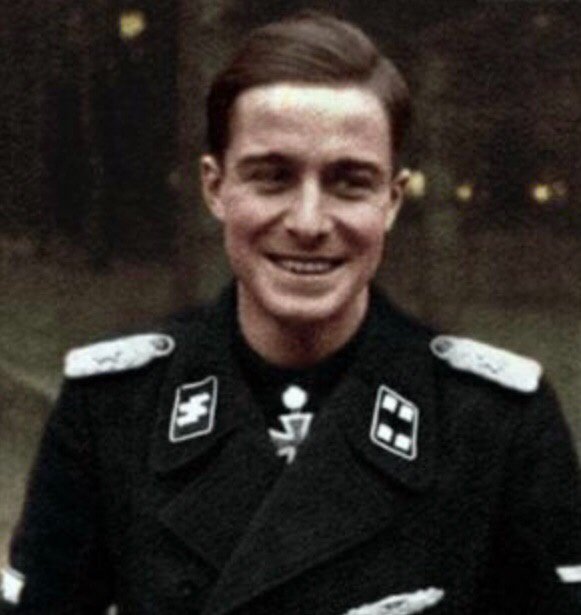
“I was a Nazi and I remain one. Today’s Germany is no longer a great nation, becoming a province of Europe. That’s why, at the first opportunity, I will settle in France.”
1967 interview with Peiper.
Joachim Peiper was born in 1915 to a middle-class German family in the Silesian region. When he turned 18, he joined the Hitler Youth and volunteered for the SS. In 1938, he was appointed Himmler’s adjutant, becoming one of his most trusted aides.
During the Second World War, he participated in the Polish campaign, receiving numerous commendations. In 1943, he went to Italy, and his unit was responsible for the Boves massacre, where 32 civilians were killed in reprisal. He then returned to the Eastern Front and the Ardennes. On December 17, 1944, his unit was responsible for the killing of an unknown number of 72 to 84 American prisoners of war, a massacre that went down in history as the “Malmédy Massacre.”
After the war, he was tried and sentenced to death by hanging, but the sentence was commuted to 10 years in prison (in my opinion because he traded his life for important information).
After his release from prison, he worked for Porsche and Volkswagen.
In 1968, a German court charged him with killing Italian civilians, but the following year the cohort ruled there was insufficient evidence to convict him.
In 1971, he moved to Treves, France, and enjoyed cordial relations with his fellow villagers. But after a few years, rumors spread that a Nazi criminal was living in the town. A few months later, his home caught fire, and Peiper’s body was found burned alive.
Despite being a proud Nazi and proudly carrying out even the most horrific orders, did this man deserve the death penalty carried out in such a manner?
Sources from the book: “Joachim Peiper. A Life Under Accusation” by Ernesto Zucconi.

0 Comments